Contact Form
Complete the fields and submit this form, and we'll reach out to you promptly.
"*" indicates required fields
Complete the fields and submit this form, and we'll reach out to you promptly.
"*" indicates required fields
Safe School Ambassadors from Sonoma County, CA provide an outline of the SSA Program.
Safe School Ambassadors from Sonoma County, CA talk about issues they encounter at school and how the SSA Program gives them tools to respond.
September 17, 2025 by Megan Trotter, TRIB Live, Tarentum, PA
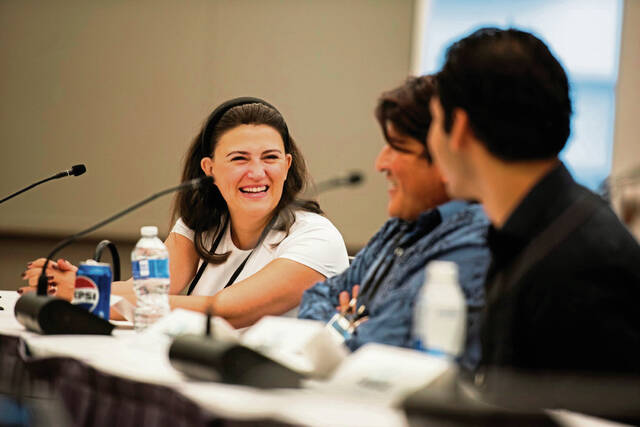
Safe School Ambassadors from Sam Rayburn High School in Pasadena, Texas, spoke on a panel about preventing violence and hate during the final day of the 2025 Eradicate Hate Global Summit in Pittsburgh, PA.
Restorative Works Magazine, 2023 Year in Review, page 15
An overview of the focus and impact of Community Matters Restorative Practices and Safe School Ambassadors Programs, from the magazine of the International Institute for Restorative Practices (IIRP).
September/October 2023, GoLocal Magazine
Community Matters CEO Erica Vogel is interviewed by Jess Taylor for Sonoma County MadeLocal Magazine.
Learn how Community Matters programs & services have helped improve school climates in the 2024-25 school year.
by Claire de Mézerville-López M.Ed M.S.
Community Engagement Specialist, IIRP
Resilience is a concept that emerged in the psychological field in the 1990’s, referring to an individual’s ability to recover from adversity. Coming to an understanding of resilience has engendered controversy: what does it take for an individual to have the golden substance of resiliency? Is it natured or nurtured? It may sound similar to talking about alchemy. I must clarify right now that my focus here is not about the individual’s capacity for resiliency. I want to talk about the community’s capacity for resiliency and how this resiliency can become strengthened through youth’s peer mentoring in school communities.
Defining Resilience & Peer Mentoring in Community
The American Psychological Association (2025) defines resilience as “the process and outcome of successfully adapting to difficult or challenging life experiences, especially through mental, emotional, and behavioral flexibility and adjustment to external and internal demands” (APA, 2025). I will address how this applies to communities in the following section.
As for peer mentoring, I will understand it as the support and advice someone receives from somebody that has experienced similar issues (The Advocacy Project, 2025). Finally, I will define community here as:
“any group sharing something in common — place (such as a city, neighborhood, or school district), experience (such as shared experience of racism), or interest (e.g., a community’s concern about poverty or violence prevention)” (University of Kansas, 2025).
So, how do we understand community resilience, specifically if we are referring to school communities, and how can peer mentoring help?
Creating Resilient Communities
Ellis and Dietz (2017) define resilient communities as those that have the following conditions:
1. The community is able to sustain economic development
2. Residents possess social capital to some degree
3. Effective bidirectional transfer of information and communication between residents and the social services agencies that serve them
4. The community is competent to support civic engagement, self-management of their health and social needs, and collective empowerment for community advocacy and engagement
These are basic conditions for communities to face and endure adversity. Considering these elements, Ellis et al. (2022) have found that policies and practices that shape the structural conditions of any community, are significant in the promotion or suppression of their ability to face adversity. Let me recap: (1) economic development, (2) social capital, (3) education and health services that work WITH the community (instead of FOR them), and (4) advocacy through civic engagement, should be a priority in any initiative towards strengthening community. It is important to consider, however, that working on these large and complex structural issues may lead adults to act without consulting or engaging youth and students.
The importance of empowering youth
Krauskopf (2014) warns against the risks of adult-centered settings and how they undermine possibilities for positive youth development. Adult-centered organizing treats children and adolescents as passive recipients of services. This means missing the opportunities that youth may have for developing skills, enhancing self-confidence, creating a sense of belonging and committing generously to giving back to their surrounding community. Engaging youth is not limited to consulting with them: it means creating an active listening space for adults to understand them and allow them to actively participate.
Peer mentoring can take different forms in that process; it may mean supporting youth to organize in small peer groups, led by some of them, and present their proposals and agendas. It may include identifying youth leaders to support kids that are falling behind academically or socially. It may also mean identifying potential leaders and allowing current leaders to foster a mentoring relationship with them so that they can become fully engaged with these initiatives. It could also mean to create talking circles to ask the youth: what kind of mentoring would you need to participate actively in the issues that we are facing right now? These types of conversations are supported by the work done by Community Matters to train youth leaders and school staff in Restorative Practices and in bystander education through the Safe School Ambassadors® program.
To some, this may seem like an unnecessary task for school communities: there’s so much work to do already! Yet, fostering student leadership will definitely create a stronger sense of collective self-efficacy in our oh-so-complex twenty-first century. There are no recipes or clear cut solutions. For communities to prepare and become ever more resilient, there’s significant work to be continued, through organizing, engaging, and advocating. Actively including youth is healthy, and doing so through horizontal exchanges that foster growth, such as receiving mentoring support from a peer, will offer a profound sense of human connection, positive opportunities for youth development and an overall strengthening of educational collectives that need to be ready to face a volatile and fast-changing world.
References
American Psychological Association (2025). Resilience. https://www.apa.org/topics/resilience
Ellis, W. & Dietz, W. (2017). A New Framework for Addressing Adverse Childhood and Community Experiences: The Building Community Resilience (BCR) Model. Academic Pediatrics, 586-593. https://www.doi.org/10.1016/j.acap.2016.12.011
Ellis, W.; Dietz, W.H., & Chen, K.D. (2022). Community Resilience: A Dynamic Model for Public Health 3.0. J Public Health Manag Pract, 28(1): S18-S26. https://www.doi.org/10.1097/PHH.0000000000001413
Krauskopf, D. (2014). Adolescencia y Educación. EUNED.
The Advocacy Project (2018). Mental Health and Peer Mentoring – Sharing Hope. https://www.advocacyproject.org.uk/news/mental-health-peer-mentoring-sharing-hope/
University of Kansas (2025). Community Toolbox. Section 2. Understanding and Describing the Community. https://ctb.ku.edu/en/table-of-contents/assessment/assessing-community-needs-and-resources/describe-the-community/main
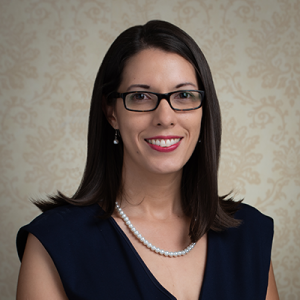 Claire de Mézerville López is a licensed psychologist from UCR (Universidad de Costa Rica). She holds a Master in Education with an emphasis on cognitive development from ITESM (Instituto Tecnológico de Estudios Superiores de Monterrey, México), and a Master of Science in Restorative Practices from the IIRP Graduate School, and is a Ph.D. ABD (all but dissertation) candidate at the Community Engagement Program at PointPark University. She is also an associate professor at Universidad de Costa Rica, and has experience as a therapist, researcher, and consultant. Claire has published papers on adolescence, restorative practices, resilience and educational psychology. Claire has worked with the IIRP since 2011, where she currently serves as a liaison to Spanish-speaking communities and organizations in Latin America and elsewhere.
by Rachel Hunkler
Community Matters and the Eradicate Hate Global Summit share the goal of empowering and engaging youth voices. We believe including young people in anti-hate and community safety efforts is critical to their success.
We know that young people’s actions can make a tremendous difference – sometimes the difference between life and death. Research on this topic indicates that approximately 80% of school shooters leak communications indicating their intentions prior to their attack. Research also tells us that peers are more likely to receive these leaked communications and are, therefore, much better positioned to identify concerning behaviors.
That’s why Community Matters and Eradicate Hate teamed up for the UP End Hate initiative, which launched in September 2024. UP End Hate is designed specifically to equip young people ages 12-22 with the knowledge and skills they need to be an upstander — someone who knows the warning signs of someone on a potential pathway to violence, pays attention to changes in peers’ behaviors, and speaks up when something is concerning.
While UP End Hate is a nationwide awareness campaign, Community Matters is piloting an in-person component in 10 middle and high schools across the United States. The pilot infuses Community Matters’ existing Safe School Ambassadors® program with additional resources and training on topics like hate online, how to tell if something is a joke, and what the warning signs are that an Ambassador should seek help for a peer.
Last semester, Community Matters trained approximately 400 students at the 10 pilot UP End Hate schools. This semester, these Ambassadors will use the newly launched UP End Hate Student Toolkit to run their own peer-to-peer campaigns to raise awareness about how students can foster resilient school communities. With pre-made posters, social media posts, daily announcement scripts, and suggested school-wide activities, the toolkit delivers a ready-made digital “campaign-in-a-box” for students to immediately use.
Eradicate Hate and Community Matters co-designed the toolkit’s campaign messaging, which focuses on three actionable categories to be an effective upstander and to create safer school communities — being kind, being curious, and being courageous. For example:
Be kind: Say “hello” to the first 10 people you see today.
Be curious: Learn the warning signs that a classmate might need extra support.
Be courageous: Speak up when you notice hateful words or actions, in person or online.
While the individual actions themselves are simple, their collective potential impact on school climate is enormous. Ambassadors at the 10 pilot schools will test out the effect these toolkits have on their school communities and share results at a virtual meeting later this spring.
In addition, as part of Family Group meetings this semester, Ambassadors will take the free UP End Hate “Hate 101” mini-course to become a certified UP End Hate Upstander. Finally, Ambassadors will be invited to join their peers around the country for a free, four-part virtual UP End Hate youth webinar series that will take place in late February and early March.
While these 10 pilot schools are part of the formal pilot program, all resources and events for UP End Hate are free and accessible online. Any student can become a certified Upstander, and any school can download and use the toolkit, regardless of any prior affiliation with the UP End Hate project. We encourage any schools, students, and educators interested in this work to visit www.upendhate.org and follow us on Instagram to get involved.
About UP End Hate:
UP End Hate is run by the Eradicate Hate Global Summit (EHGS), Community Matters, The Reilly Group, and Moonshot, with input from a 20-member Youth Advisory Council. The FY23 Department of Homeland Security Targeted Violence and Terrorism Prevention (TVTP) grant program funds UP End Hate. All materials hosted on the UP End Hate website are free and accessible to the public. The campaign is anonymous and does not collect any personally identifiable information.

Rachel Hunkler serves as the Director of Programming and Evaluation at the Eradicate Hate Global Summit. In this role, she oversees the strategic design, execution, evaluation, and scaling of the Summit’s yearlong programs and the integration of these programs into the Summit’s Working Groups. Hunkler provides leadership and expertise on efforts to gather, analyze, and disseminate impact data on the Summit’s Working Groups and programs. She specializes in instructional design, training facilitation, program management, and monitoring and evaluation. Read Rachel’s full bio here.
It’s hard to believe that it’s been 25 years since the tragic mass shootings on April 20, 1999 at Columbine High School in Littleton, Colorado. I can vividly remember watching the horror on live television as students and staff were desperately climbing out of windows trying to get out of harm’s way any way they could.
It was a seminal moment in US history, one that was seared in our individual and collective consciousness.
Within weeks of the tragedy, I found myself deeply troubled and compelled to take action. That call to action drew upon my life experiences, both as a victim of bullying and as an educator committed to youth empowerment, believing that young people were an underutilized and untapped resource who were in the best position to make our school safer.
I never imagined that 25 years later, the Safe School Ambassadors Program (SSA), would not only survive, but thrive in schools everywhere. Such a simple and powerful idea; identify and enroll diverse student leaders, equip, and empower them with the motivation, tools, and support to be Upstanders. SSA mobilizes Upstanders willing and ready to say and do something when they witness or know of injustice, hatred, bullying and cyberbullying in their school community.
Think about it. How many students, many now adults, parents, and teachers who have been impacted and forever changed by the opportunity to be a part of the Safe School Ambassadors movement.
I share this with you to honor every Community Matters (CM) trainer, staff member and board member (past and present), and school officials who believed in us. Every Program Advisor, every Family Group Facilitator, every Administrator, every Ambassador, every funder, every donor, every parent, and many others, who stood with us in the development and implementation of SSA.
I can’t name everyone individually, but I want to say a special thanks to Chris Pack, who side-by side, contributed mightily to the success of CM and SSA. And to John Linney, master trainer and co-author of the Safe School Ambassadors book. I also want to express gratitude to Erica Vogel, CEO and the CM staff team who kept CM afloat during the pandemic.
Lastly, my heartfelt appreciation to the “road warrior” trainers who by planes, trains, automobiles, and determination showed up and delivered time after time, even when it wasn’t easy.
With a sense of perspective, I feel blessed to have had the privilege of knowing and working with so many dedicated and amazing people. I have been fortunate to be part of a community and a movement that wakes up courage, empowers young people to be active contributors and literally saves lives, emotionally and physically. This is a legacy we all get to share.
The world needs our work, our voices, and our commitment more than ever. We have more to do to help schools become communities of compassion. CM is in a unique and important position to leverage our experience and our success, allowing us to not only wake up the courage of young people but also inspire educational leaders. Educators are grappling with how to build a positive school culture, address school violence, teach academics, retain good staff, and regain the support of families and the broader community.
Despite the challenges and the tragedies that plague many schools, our Community Matters mission continues to guide us through the dark and into the light. On this auspicious day of remembrance, I remain hopeful, grateful, even eager to be in the “fire” of public education at a time of such great need.
As individuals we are effective, but together we are a force, a force that can provide hope, tools, resources, and support to youth and adults in schools everywhere.
In the spirit of community,
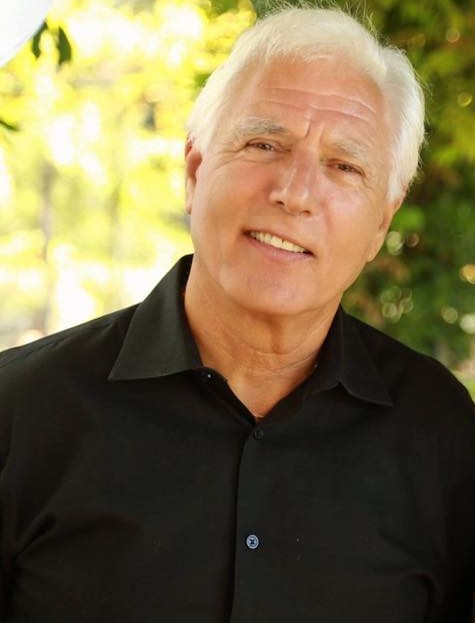
Rick Phillips
Rick Phillips is the founder and former Executive Director of Community Matters, and co-creator of the Safe School Ambassadors® Program.