March 2026 Issue
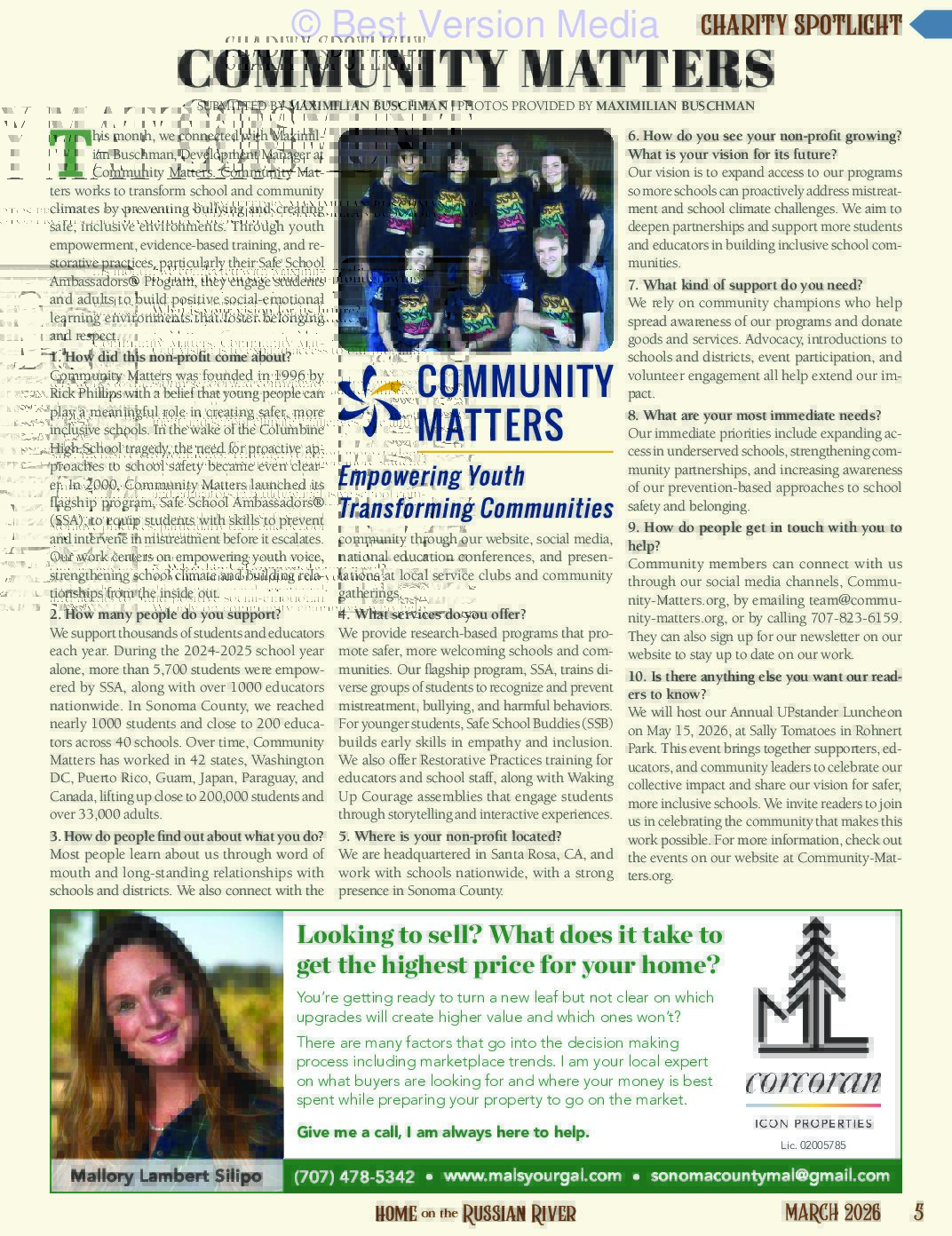
Community Matters was featured in the Charity Spotlight page in Home on the Russian River Magazine.
March 2026 Issue
Community Matters was featured in the Charity Spotlight page in Home on the Russian River Magazine.
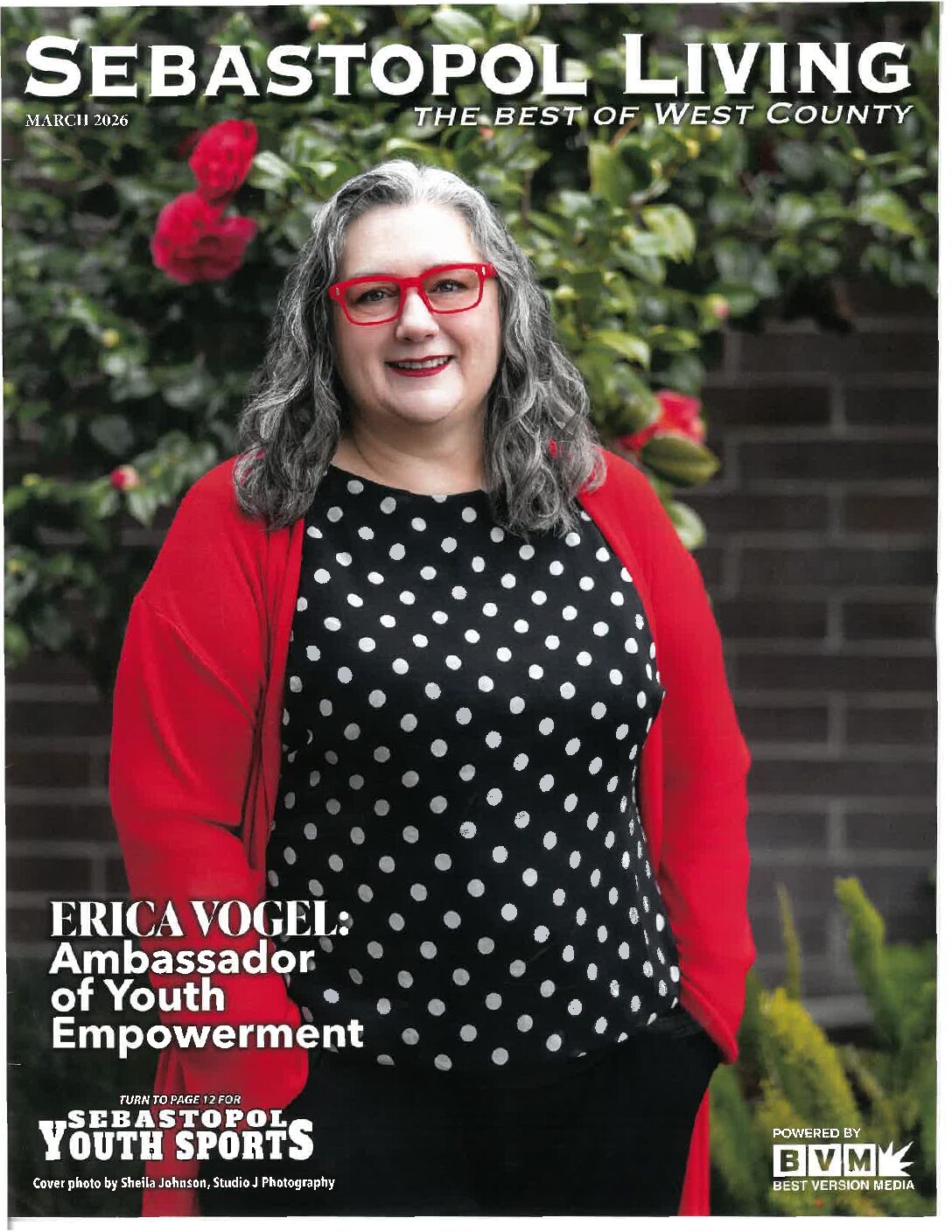
March 2026 Issue by Catherine Hughes, photos by Sheila Johnson
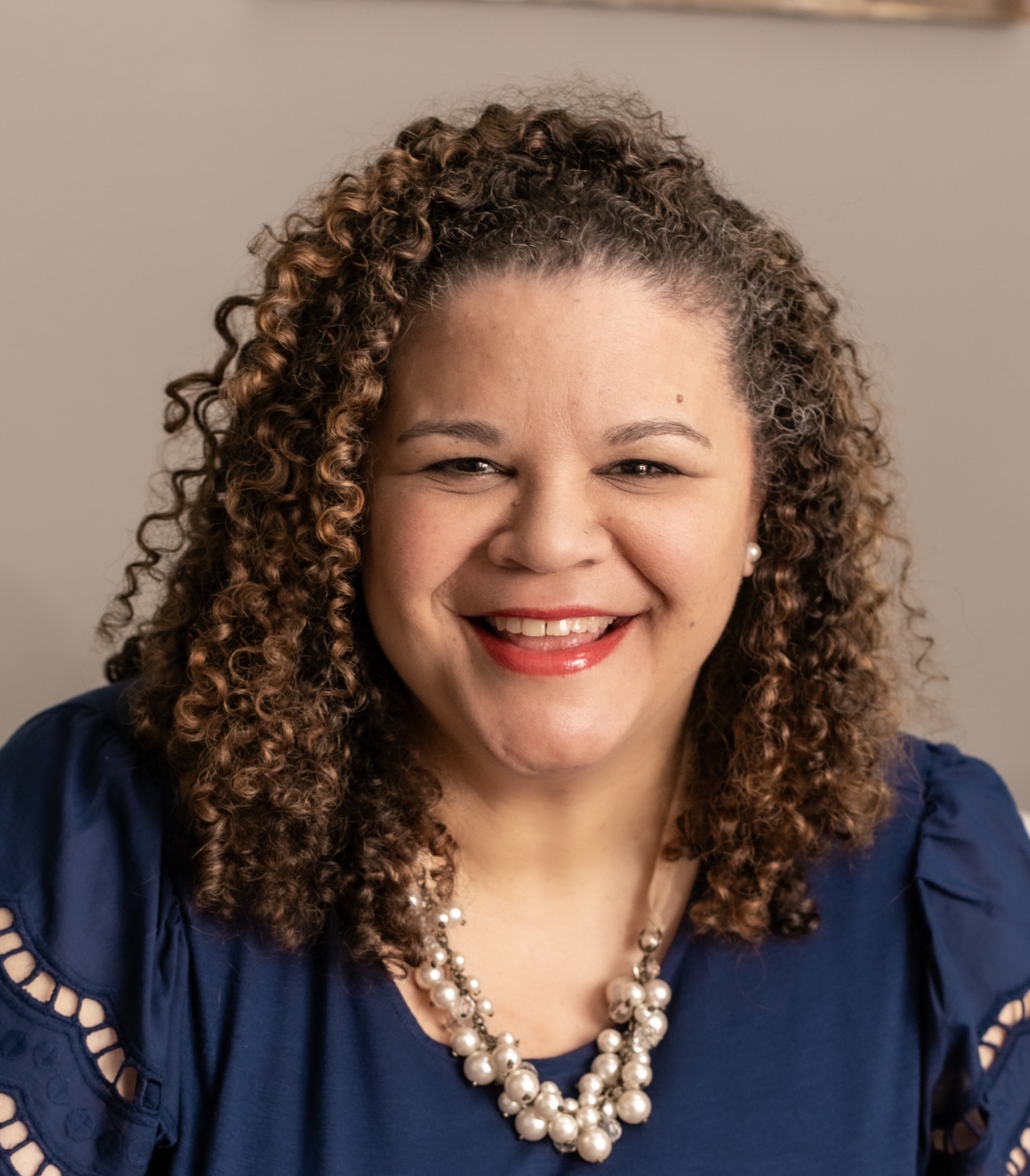
Community Matters’ CEO, Erica Vogel, is featured in the March issue of Sebastopol Living. The article highlights her leadership journey and the impact of Safe School Ambassadors, which has now reached more than 2,200 schools and 180,000 students worldwide. This recognition reflects the strength of our community and the young people who lead change in their schools every day.
Sebastopol Living Magazine – March 2026
By Ashley Ranger
Published December 4, 2025
Youth today are experiencing constant stimulation. If they are not on their phones, they are staring at a computer screen or TV screen for most of their day. While we have seen the constant growth of technology entering our everyday lives, young people have become highly dependent on it for social connection.
The COVID-19 pandemic fostered an environment where young people only had technology to connect, even if that connection was artificial. These artificial connections between peers have only increased anxiety when it comes to person-to-person interactions. When students returned to school, they came face-to-face with tangible reality which caused them to further isolate themselves. Technology allows people to mask, even play a role, but in person there are no filters.
Coming back from years of digital isolation caused spikes in anxiety and depression amongst youth. With no filters comes insecurity, which causes the need for students to protect themselves, and sometimes protecting themselves means putting down others. According to the CDC, in 2023 40% of students reported feelings of isolation, loneliness, and sadness, 20% reported having suicidal ideation. This statistic shows how much of an impact the COVID-19 pandemic caused, and that students are still learning to heal from it. The question is, how does the Safe School Ambassadors Program work to tackle the youth mental health crisis?
The Safe School Ambassadors Program is an evidence-based program that empowers youth to create safe, inclusive, and welcoming school climates. The program teaches ‘Ambassador Actions’ that students can use to safely intervene when they witness bullying and stop it before it can turn into physical violence. One of the actions is called “Getting Help” which prepares students to notice when something is too big for them to handle (i.e. self-harm, substance abuse, etc.) and to get help by finding an adult on campus they trust. The action of “Getting Help” can greatly impact the youth experiencing a crisis because someone took the time to notice their need. As we continue to show youth how to identify when their peers need help, we can significantly address the prevalence of mental health problems faced by youth.
Today, youth need us more than they ever have before. Let’s build a student-led safety net by actively listening when youth come to us with anxieties and harmful situations. For more information about how the Safe School Ambassadors Program fits your school, reach out to Community Matters! Together we can build safer, more connected school communities.
___________________________________________________________________________________________________________________________

Ashley Ranger is a Program & Training Coordinator at Community Matters in Santa Rosa, California. She has more than seven years of experience working alongside young people and families to build safe, welcoming, and connected communities. In her current role, she develops youth programs and coordinates professional development for school staff and administrators. Ashley believes in supporting youth to lead with empathy, speak up for others,
and create positive change in their schools and neighborhoods. She brings a background in English and a trauma-informed, relationship-centered approach to her work.
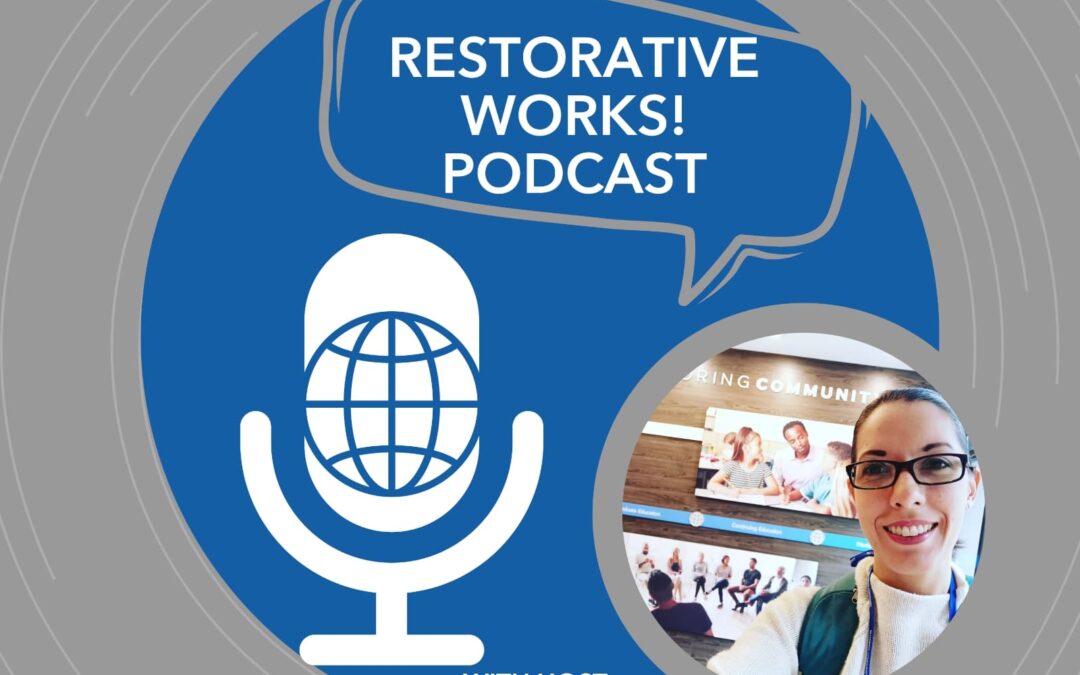
November 6, 2025 by Claire de Mézerville López.
Community Matters’ CEO, Erica Vogel, and several Safe School Ambassadors, including SSA alum and current Alumni Coordinator Marin Broadbent Bell, were featured on the IIRP Restorative Works! Podcast.
They shared powerful stories about their experiences and what it takes to build safer and more connected school communities.These stories show the lasting impact of Community Matters programs and our supporters, reflected in the way students continue to strengthen their lives and communities long after the program ends.
Restorative Works! Podcast – Erica Vogel
Restorative Works! Podcast – Marin Broadbent-Bell
By Kerry Rego
Published October 2, 2025
Walking onto school campuses to talk to parents, administrators, and students always feels charged with electricity. I’m often called in after something awful has happened such as when a social media challenge gets out of hand, when students have begun bullying others online, or parents grow concerned about their children’s digital behavior. The adults that greet me are clearly worried and the kids reflect their energy – these campuses are tense.
Parents and administrators have a limited technology background and students know more than enough to be a danger to themselves and their friends. As a social media and technology educator, I learn what the problem is and develop solutions that match the needs of my audience.
The administrators and I often agree to address the audiences in two groups – parents and children. I speak to children during the day in assemblies then parents in the evening. The presentations are designed as companion pieces, giving all parties the same language in order to communicate with each other more effectively.
I encourage you to take a look at the Upcoming Workshops and Webinars offered by Community Matters or reach out to them to coordinate a program for your campus.
Every presentation I give includes a Family Safety Plan for Bullying, one geared for children and one for adults. You and your child might work through a bullying situation together but that won’t always be the case. Your child may be navigating it on their own without your knowledge. It’s a scary thought but our job is to teach them how to be safe because we won’t always be with them. They may find themselves helping a friend through a difficult situation and their action list will guide them through it.
Treat these safety lists like an emergency drill – children especially need to know the plan and they need to practice it. Print and review the plan as a family to make sure everyone knows what to do when/if an emergency happens.
The Family Safety Plans below are adapted from advice listed on the U.S. federal government website StopBullying.gov.
Family Safety Plan for Parents:
*There are no current federal laws that apply to bullying but you can learn more about the U.S. Department of Education’s Office for Civil Rights via the U.S. Department of Justice’s Civil Rights Division and options available to you and your child on StopBullying.gov.
Family Safety Plan for Kids:
Downloads
PDF by Kerry Rego
Google Doc Kids & Parents
____________________________________________________________________
Kerry Rego is a social media consultant, trainer, author, and speaker. Specializing in social media marketing, Kerry is associate faculty at Santa Rosa Junior College, a subject matter expertfor California Community Colleges, and a former lecturer at Sonoma State University. She has authored four books about social media strategy and reputation management.
September 17, 2025 by Megan Trotter, TRIB Live, Tarentum, PA
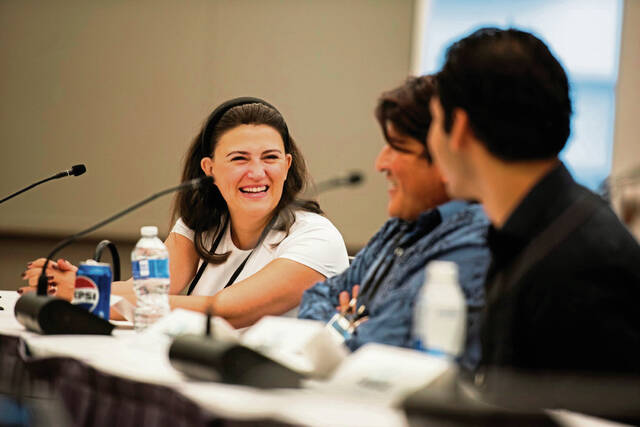
Safe School Ambassadors from Sam Rayburn High School in Pasadena, Texas, spoke on a panel about preventing violence and hate during the final day of the 2025 Eradicate Hate Global Summit in Pittsburgh, PA.
Restorative Works Magazine, 2023 Year in Review, page 15
An overview of the focus and impact of Community Matters Restorative Practices and Safe School Ambassadors Programs, from the magazine of the International Institute for Restorative Practices (IIRP).
September/October 2023, GoLocal Magazine
Community Matters CEO Erica Vogel is interviewed by Jess Taylor for Sonoma County MadeLocal Magazine.
By Erica Vogel, CEO, Community Matters
Published August 13, 2025
On July 30, 2025, Governor Gavin Newsom issued an executive order to confront rising suicide rates and growing disconnection among California’s boys and young men, calling for coordinated mental health, education, and workforce support across the state. This action shines a spotlight on a crisis that extends far beyond California. Research shows young men report shrinking social circles and fewer close friendships: risk factors for loneliness and mental health struggles that school communities feel every day.
At Community Matters, we see what’s possible when students are equipped to look out for one another. Our Safe School Ambassadors® (SSA) Program is a proven, peer-led model that helps prevent bullying, reduce isolation, build connections, and create healthier school climates. This work directly advances the intent of the Governor’s order and is urgently needed nationwide.
How the SSA Program Aligns with the Executive Order
The SSA Program is a proven, peer-led model that uniquely addresses many of the challenges outlined in the Governor’s directive. It transforms students into “Upstanders” who use their influence among peers to prevent and intervene in incidents of bullying, mistreatment, and social isolation. This work directly advances several components of the executive order:
Reversing the Crisis of Loneliness and Disconnection
Governor Newsom highlights the alarming number of boys and young men who report having no close friends, with nearly 1 in 4 men under 30 expressing deep social disconnection. SSA builds authentic connection among youth by training and supporting them to recognize and respond compassionately to emotional distress in their peers.
By leveraging students’ natural social networks, the program ensures that no student, including boys who often mask their hurt as anger or defiance, feels invisible. SSA helps people connect, belong, and support one another in a safe, school-based environment.
Promoting Healthy Masculinity and Peer Support
As the executive order emphasizes, many young men suffer in silence due to outdated gender norms and a lack of emotionally attuned male role models. SSA empowers male students to lead with empathy, courage, and emotional literacy modeling healthy masculinity for their peers.
Through facilitated dialogues and ongoing adult and peer mentorship, SSA normalizes asking for help and talking about feelings, equipping students with the tools to take positive action rather than act out. In schools across the United States and beyond our borders, we have seen this approach reduce incidents of aggression, isolation, and self-harm among young people.
Supporting Early Intervention and Preventing Punitive Discipline
The data is clear: boys, especially boys of color, are suspended, expelled, or referred to law enforcement at far higher rates than their peers, often for behaviors that may be expressions of trauma. The SSA Program creates a culture of peer accountability and positive behavior reinforcement that prevents issues from escalating into punishable infractions.
Instead of defaulting to disciplinary exclusion, the program fosters a restorative school culture where peer relationships can address root causes and build resilience, helping young people stay connected to their school communities and invested in their futures.
Elevating Youth Leadership and Career Pathways
The SSA program instills leadership, communication, and conflict resolution skills that are essential for success in school, work, and life. By identifying and nurturing diverse male students as Upstanders and leaders, SSA opens doors to broader educational and career opportunities, particularly for those who might not see themselves as “traditional leaders.”
Our alumni have gone on to become social workers, educators, youth advocates, and civic leaders, often citing SSA as a pivotal turning point in discovering their sense of purpose and self-worth.
Addressing Equity and Access Barriers
Governor Newsom rightly underscores that boys and young men of color, particularly Black, Latino, and Indigenous youth, are among the most underserved by current mental health systems. SSA prioritizes culturally responsive engagement and is adaptable to the needs of diverse school communities.
Because the program is embedded in schools and led by peers, it removes many of the access barriers (like stigma, cost, and transportation) that prevent boys from receiving timely support.
A Sustainable, Scalable, and Proven Solution
While much of the state’s recent funding is short-term, SSA offers a sustainable model that schools can continue through trained site facilitators and community partnerships. Community Matters has already impacted over 170,000 students in more than 2,100 schools across 42 US states, 2 US Territories, Washington DC, Paraguay, Japan, and Canada, with data showing decreased bullying, improved school climate, and strengthened student mental health.
A Community-Based Answer to a Statewide and National Crisis
Governor Newsom’s courageous, timely call to address the mental health and social challenges facing young men demands proven solutions. Community Matters and the SSA Program specifically stand ready to partner with districts, counties, and community organizations to scale what has worked for 25+ years. Rather than creating something new, we will expand and deepen a model already delivering results: equipping students with the tools to lead, connect, and care for themselves and others. In doing so, we can transform schools into powerful incubators of healing, belonging, and hope. When we invest in peer leadership, we don’t just reduce harm; we grow hope.
____________________________________________________________________
Erica Vogel is a proud mom of 2 boys, now young men!
Both boys were Safe School Ambassadors in their high school years.

Erica has extensive experience in youth development and programming with a specialization in developing and implementing youth empowerment programs for disadvantaged and culturally diverse young people. Prior to joining Community Matters, she worked in high level leadership positions with the YMCA, the American Heart Association and Big Brothers Big Sisters. Erica has worked for Community Matters since 2010 and in 2020 took the reigns as the CEO. Erica holds a B.A. in Management and Organizational Development from Spring Arbor University.
by Claire de Mézerville-López M.Ed M.S.
Community Engagement Specialist, IIRP
Resilience is a concept that emerged in the psychological field in the 1990’s, referring to an individual’s ability to recover from adversity. Coming to an understanding of resilience has engendered controversy: what does it take for an individual to have the golden substance of resiliency? Is it natured or nurtured? It may sound similar to talking about alchemy. I must clarify right now that my focus here is not about the individual’s capacity for resiliency. I want to talk about the community’s capacity for resiliency and how this resiliency can become strengthened through youth’s peer mentoring in school communities.
Defining Resilience & Peer Mentoring in Community
The American Psychological Association (2025) defines resilience as “the process and outcome of successfully adapting to difficult or challenging life experiences, especially through mental, emotional, and behavioral flexibility and adjustment to external and internal demands” (APA, 2025). I will address how this applies to communities in the following section.
As for peer mentoring, I will understand it as the support and advice someone receives from somebody that has experienced similar issues (The Advocacy Project, 2025). Finally, I will define community here as:
“any group sharing something in common — place (such as a city, neighborhood, or school district), experience (such as shared experience of racism), or interest (e.g., a community’s concern about poverty or violence prevention)” (University of Kansas, 2025).
So, how do we understand community resilience, specifically if we are referring to school communities, and how can peer mentoring help?
Creating Resilient Communities
Ellis and Dietz (2017) define resilient communities as those that have the following conditions:
1. The community is able to sustain economic development
2. Residents possess social capital to some degree
3. Effective bidirectional transfer of information and communication between residents and the social services agencies that serve them
4. The community is competent to support civic engagement, self-management of their health and social needs, and collective empowerment for community advocacy and engagement
These are basic conditions for communities to face and endure adversity. Considering these elements, Ellis et al. (2022) have found that policies and practices that shape the structural conditions of any community, are significant in the promotion or suppression of their ability to face adversity. Let me recap: (1) economic development, (2) social capital, (3) education and health services that work WITH the community (instead of FOR them), and (4) advocacy through civic engagement, should be a priority in any initiative towards strengthening community. It is important to consider, however, that working on these large and complex structural issues may lead adults to act without consulting or engaging youth and students.
The importance of empowering youth
Krauskopf (2014) warns against the risks of adult-centered settings and how they undermine possibilities for positive youth development. Adult-centered organizing treats children and adolescents as passive recipients of services. This means missing the opportunities that youth may have for developing skills, enhancing self-confidence, creating a sense of belonging and committing generously to giving back to their surrounding community. Engaging youth is not limited to consulting with them: it means creating an active listening space for adults to understand them and allow them to actively participate.
Peer mentoring can take different forms in that process; it may mean supporting youth to organize in small peer groups, led by some of them, and present their proposals and agendas. It may include identifying youth leaders to support kids that are falling behind academically or socially. It may also mean identifying potential leaders and allowing current leaders to foster a mentoring relationship with them so that they can become fully engaged with these initiatives. It could also mean to create talking circles to ask the youth: what kind of mentoring would you need to participate actively in the issues that we are facing right now? These types of conversations are supported by the work done by Community Matters to train youth leaders and school staff in Restorative Practices and in bystander education through the Safe School Ambassadors® program.
To some, this may seem like an unnecessary task for school communities: there’s so much work to do already! Yet, fostering student leadership will definitely create a stronger sense of collective self-efficacy in our oh-so-complex twenty-first century. There are no recipes or clear cut solutions. For communities to prepare and become ever more resilient, there’s significant work to be continued, through organizing, engaging, and advocating. Actively including youth is healthy, and doing so through horizontal exchanges that foster growth, such as receiving mentoring support from a peer, will offer a profound sense of human connection, positive opportunities for youth development and an overall strengthening of educational collectives that need to be ready to face a volatile and fast-changing world.
References
American Psychological Association (2025). Resilience. https://www.apa.org/topics/resilience
Ellis, W. & Dietz, W. (2017). A New Framework for Addressing Adverse Childhood and Community Experiences: The Building Community Resilience (BCR) Model. Academic Pediatrics, 586-593. https://www.doi.org/10.1016/j.acap.2016.12.011
Ellis, W.; Dietz, W.H., & Chen, K.D. (2022). Community Resilience: A Dynamic Model for Public Health 3.0. J Public Health Manag Pract, 28(1): S18-S26. https://www.doi.org/10.1097/PHH.0000000000001413
Krauskopf, D. (2014). Adolescencia y Educación. EUNED.
The Advocacy Project (2018). Mental Health and Peer Mentoring – Sharing Hope. https://www.advocacyproject.org.uk/news/mental-health-peer-mentoring-sharing-hope/
University of Kansas (2025). Community Toolbox. Section 2. Understanding and Describing the Community. https://ctb.ku.edu/en/table-of-contents/assessment/assessing-community-needs-and-resources/describe-the-community/main
Claire de Mézerville López is a licensed psychologist from UCR (Universidad de Costa Rica). She holds a Master in Education with an emphasis on cognitive development from ITESM (Instituto Tecnológico de Estudios Superiores de Monterrey, México), and a Master of Science in Restorative Practices from the IIRP Graduate School, and is a Ph.D. ABD (all but dissertation) candidate at the Community Engagement Program at PointPark University. She is also an associate professor at Universidad de Costa Rica, and has experience as a therapist, researcher, and consultant. Claire has published papers on adolescence, restorative practices, resilience and educational psychology. Claire has worked with the IIRP since 2011, where she currently serves as a liaison to Spanish-speaking communities and organizations in Latin America and elsewhere.