Author: Geo Howard

Restorative Principles and Practices: Skills for Creating a Restorative School Culture

January 14 – 15, 2020

8:30am-3:00pm

Location:  Arcohe School,  Herald, CA

Cost: $265 per person

Limited to 35 participants – Register today!

This two-day experiential training will answer those questions and more. Using engaging activities, participants will understand how to integrate theory into practice. Participants will:

  • Learn about the principles and key elements of Restorative Practices
  • Understand the relationship between Restorative Practices and Restorative Justice
  • Gain skills and tools for leading restorative circles
  • Develop strategies for overcoming the challenges to effective implementation
  • Recognize the benefits of Restorative Practices and their positive impacts on school discipline, suspensions and overall climate

To register and pay by credit card, please complete the form below.

To register and pay by check, please contact Raedene Simson at 707-823-6159 x100 or email: raedene@community-matters.org

Strategies for Successful Implementation of Restorative Practices: Leading the Change – hosted by RESIG

Wed. January 22, 2020

8:30 am – 3:30 pm

Hosted by: Redwood Empire Schools Insurance Group (RESIG), Windsor, CA

Cost:  $135 per person (lunch provided)

Limited to 35 participants – Register today!

This one-day training is intended for administrative-level staff with responsibility for school safety, climate, and discipline. It provides an overview of restorative practices and its relationship to discipline, school climate, and its roots in restorative justice.

Participants will learn:

  • The principles and key elements of Restorative Practices
  • The benefits of Restorative Practices and its positive impact on school discipline, suspensions and overall climate
  • How to operationalize and implement Restorative Practices in their district and school
  • Strategies for overcoming the challenges to effective implementation

To register and pay by credit card, please complete the form below.

To register and pay by check, please contact Raedene Simson at 707-823-6159 x100 or email: raedene@community-matters.org

What are “Restorative Practices” in Schools? Hint: It’s Not Restorative Justice

by Paul Osincup, Restorative Practices Trainer, Community Matters

One of the first questions I ask administrators and teachers when I facilitate trainings on restorative practices is how much experience they have with it or what they know about it. After working with educators in school districts all over the country, here are three things that are consistent everywhere I go:

  1. Administrators and teachers are always open to learn about strategies that will help them decrease classroom disruption and increase social responsibility and inclusivity.
  2. When I first mention restorative practices, many people in the room think I’m only talking about restorative justice.
  3. Educators are predisposed to “initiative fatigue” and don’t want this to be just another thing to add to their plate.

Restorative Justice (RJ) is a formal process where a person who has caused harm to an individual or group has the opportunity to meet with those who have been harmed or affected. They create a shared agreement about how the offender can repair the harm and all parties can reintegrate and move forward. RJ is used in the criminal justice system as well as at some colleges and universities and K-12 schools in conjunction with traditional disciplinary procedures.

Restorative Practices (RP) according to Ted Wachtel, Founder of the International Institute for Restorative Practices, RP is “…a social science that studies how to build social capital and achieve social discipline through participatory learning and decision-making.”

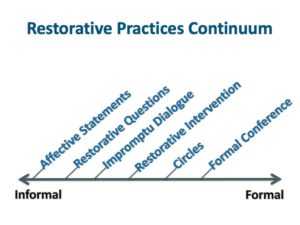
The simplest way to understand it is that restorative practices involves a continuum of interventions and strategies that are both proactive and responsive. Restorative Justice is ultimately a subset of restorative practices and is primarily only responsive in nature. On the continuum below, RJ would be considered a form of “Formal Conference” on the right.
Proactive RP Strategies:

  • Strengthen Relationships
  • Build Trust
  • Develop Community

Responsive RP Strategies:

  • Manage Conflict and Misbehavior
  • Meet Needs/Repair Harm
  • Restore Relationships

At Community Matters, we know it’s crucial to have evidence-based strategies to respond to disruptive behavior, and we also know that prioritizing relationships and connections creates a community where students develop a sense of social discipline resulting in less disruptive incidents to respond to.

So, how does it all work?

Well, that usually takes us two full days to explain but I can at least give you some proactive and responsive examples based on the RP continuum. For example, classroom circles (second from the right on the continuum) can be used proactively or in response to an incident.

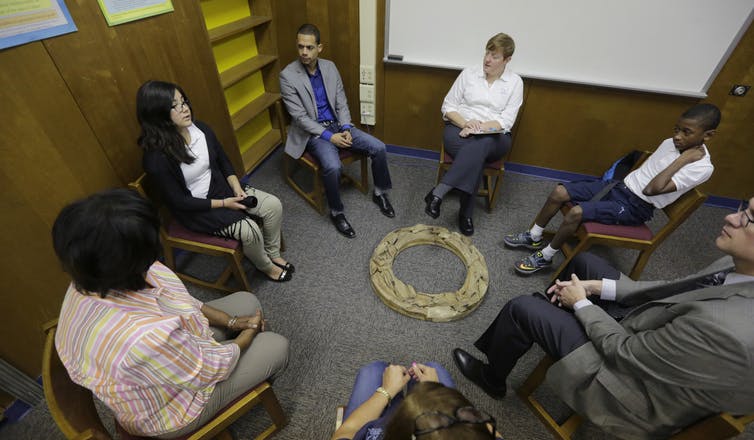
A teacher who’s trained to facilitate classroom community building circles will use circle guidelines, a talking piece, engaging prompts, and activities to help students get to know one another personally throughout the year and create meaningful connections with their classmates. Once these connections are established and the kids begin to develop trust with each other and a familiarity with using circles to speak honestly and listen actively, that same teacher may choose to use a circle to respond to an issue. For instance, she may ask the students to respond to a note she received that the class was not good for the substitute the day before.

Ideally, about 80% of the RP work that is being done in the school is to build community to foster a positive school climate, while 15 – 20% is responsive in nature.
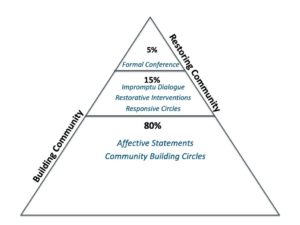
Whether I’m facilitating a workshop focused more on community building and the proactive side of things or on facilitating formal conferences to respond to student behavior, I’ve found it’s important to remind the participants that restorative practices is not a separate curriculum or initiative designed to replace your current curricular, behavioral intervention, or disciplinary models. Rather, RP is a way of being. It’s a tool to enhance your current practices, and a catalyst for youth voice. As a former Associate Dean of Students and university disciplinary officer, I understand the overwhelm and “initiative fatigue” that happens when we’re given a new program or curriculum to add to our plate. What I love about restorative practices, however, is that it’s really just a collection of tools you can incorporate into your school culture as you see fit.

Restorative practices help kids learn the basic skills it takes to be a member of a community, like empathy, listening, and conflict resolution, so it’s easier for you to teach them more complex skills like reading, writing, and math. Reclaiming the role of relationships and connection in schools isn’t just another thing to add to our plate… it is the plate.

Five Strategies to Promote Equity and Compassion in Schools: A Road Map for Reducing Physical & Emotional Violence


This workshop has been postponed, please check back for new date in 2020.


Effectively stopping hate and promoting inclusivity will not happen unless schools also have a well-defined culture and climate improvement plan –  one that identifies strategies that result in a safer and more compassionate school that is built on a foundation of empathy and equity.

This one-day workshop will provide five key strategies that when implemented with fidelity have proven to increase school connectivity and safety, create greater respect for diversity, improve attendance and increase academic achievement:

  • Conducting forums, class discussions and assemblies that can break down barriers and challenge stereotypes, prejudice and assumptions
  • Increasing youth empowerment and youth voice opportunities
  • Increasing professional development for all staff focused on skills that strengthen relationships and connections between staff and students
  • Implementing effective SEL curriculum and programs
  • Instituting discipline policies and practices that are corrective and restorative

National Bullying Prevention Month – The Power of Student Voice

by Jade Sizemore, Outreach & Program Coordinator, Community Matters

Bullying can take many forms, from physical aggression and intimidation to more subtle behaviors that might not be apparent to an onlooker. In honor of National Bullying Prevention Month, we would like to draw attention to all types of bullying, especially those that are less obvious yet pervasive. Seemingly subtle put-downs, teasing, and acts of exclusion, are all forms of mistreatment that can lead a child to feel insecure and unsafe.

With teachers and administrators already facing unmanageable workloads, we must begin to view students as capable contributors to a culture of change. Student bystanders see, hear, and know things adults don’t, can intervene in ways adults can’t, and are often on the scene of an incident before an adult. They are the first “boots on the ground”, and are a critical resource for positively impacting the crisis of bullying in our schools.

Given our experience with providing support, training and consultation to more than 2,000 schools, we know the “inside-out” approach is key to successfully shifting this social paradigm. This relationship-based approach is built on a foundation of restorative practices and utilizes students as resources for minimizing and preventing acts of bullying and violence. It emphasizes the power of student voice and the importance of youth and adult relationships.

Let’s do more than instruct our youth. Let’s empower them.

Using a peer-to-peer approach that empowers student voice is the quickest, most effective, and most cost-efficient way to change social norms on campus. By training the socially influential leaders of each clique on campus to be examples of courage and compassion, the social acceptability of bullying can be eradicated. This is the model employed by our Safe School Ambassadors® Program (SSA).

Evidenced-based research has proven that implementing SSA is a long-term, sustainable solution. For any school climate improvement program to be impactful, daily attention must be given to even the most subtle discrimination, intimidation, exclusion, and microaggressions. Here are some things to start paying attention to today:

• Ingenuine or passive-aggressive compliments
• Students being called by new nicknames- possibly an insult or type of taunting
• Gossip- both on and off-campus, including stories related to social media
• Exclusion or withdrawal
• Unexplained absences or complaints of feeling unwell

Bullying is not an inevitable act of youth. It is a conditioned behavior that can continue into adulthood. But there is a solution. Intervention must be swift, and discipline needs to be focused on restoration rather than punishment. Community Matters offers programs and services that help to create educational environments where learning potential is maximized, discipline incidents are reduced, and children can become caring, responsible citizens.

This work we do is vital, and we look forward to continuing collaborative partnerships with those who also believe that compassion and empathy are the key to our future. We extend our appreciation to all the organizations around the country that help to shine a spotlight on this urgent epidemic. And finally, we are ever-grateful for the thousands of students who day-in and day-out express their courage and speak up when they encounter meanness, intolerance and injustice. Together we are making a difference.

How Youth Empowerment Leads to a Positive School Climate and Academic Success

By Diana Curtin, CEO Community Matters

When effective youth empowerment is integrated as an integral way of operating, it is transformative for students, adults and schools. National best practices and current research validates that when schools make youth empowerment a cornerstone of their comprehensive school climate efforts, schools become communities where staff and students feel connected. The Center for Disease Control and Prevention reports that feeling connected at school is the strongest protective factor for students to decrease substance use, school absenteeism, early sexual initiation, and violence; and notes the strong correlation between school connectedness and academic success.

We define youth empowerment as an attitudinal, structural, and cultural process whereby young people gain the ability, authority, and agency to make decisions and implement change in their own lives and the lives of others, including youth and adults. In schools where young people are empowered to have influence on decisions and afforded opportunities to lead and serve, they naturally feel more self-confident and have an increased sense of pride, ownership and connectedness for and at their school. This sense of empowerment naturally leads to a more positive school climate that supports increased competence, academic achievement and overall student success.

Best practices for increasing student voice and empowerment in schools include offering a variety of opportunities for students to have influence in decision making in the classroom, on the playground, for the campus and for the school. Even the youngest of students have valuable insight and can provide input and ideas, they just need the avenue and encouragement to be contributors and to be heard and acknowledged. It makes sense to consider and value the opinions of the largest population on campus – the students. The following youth empowerment opportunities incorporate leadership, service, input and decision making:

  • Serving on a climate committee, site council, parent-student organization etc.
  • Student Council and committees
  • Student led clubs and initiatives that they drive
  • Student led campaigns that promote a value or initiative they stand behind
  • Leadership opportunities for more than just the leadership classes (consider the playground/campus, classrooms, and projects)
  • Community service opportunities for the school and community that include a service-learning component
  • Peer mediating, mentoring and tutoring
  • Restorative Practice leaders
  • Serving as a Safe School Ambassador

As the CEO for Community Matters, I am a firm believer and advocate of our evidence-based Safe School Ambassadors® (SSA) Program as a best practice youth empowerment platform that has been active in 2,000 schools across the US and five countries. I have witnessed how this program transforms the lives of students and schools by empowering and equipping young people to find and use their voice to effect positive change.

The SSA Program fosters school safety by empowering influential students to safely intervene when they witness mistreatment such as bullying, cyberbullying and other harmful behaviors that can lead to tragedies such as suicide and gun violence. Consider this incredible statistic: on average, student Ambassadors intervene with actions two or more times per week. During a school year, these individual actions add up to more than 2,400 interventions, which impacts the entire school by establishing a more positive climate and culture.

SSA is a long-term prevention and early intervention program. Because climate and social norms in a school are created over time, it requires a concentrated and time-oriented approach to change the established norms. Therefore, the SSA Program is most successful when it is implemented and championed with a long-term strategic approach in mind. It is most effective when implemented over a 3-year timeframe, allowing it to develop strong roots that anchor it firmly into school culture and practice. After the first three years of Community Matters providing the SSA Training, schools are provided the opportunity to move into a sustainability model whereby the school takes over implementation and leadership of the program. With this approach, the SSA Program and the premise of effective youth empowerment become embedded into the school practices as a way of thinking, communicating and behaving.

When effective youth empowerment becomes the way of operating, school climate becomes more positive; one built on relationships, inclusivity and connection. As the school climate warms, students feel safer, more engaged, and are better equipped to lean in and learn. When these conditions are present, we see academic achievement and overall student success increase.

Student ambassadors train against bullying, violence

September 9, 2019 KUAM News

About 400 recruited students from nine private schools and one public high school participated in the two-day Safe School Ambassadors® training that was hosted for the sixth year by the Judiciary of Guam in partnership with the Guam Department of Education.

Read the article

Belmont High Safe School Ambassadors

Interviews with Safe School Ambassadors from Belmont High School in Los Angeles, showing how SSA impacted students at this urban inner-city school.

Introduction to Safe School Ambassadors

Rick Phillips, founder of Community Matters, provides an overview of the benefits of the Safe School Ambassadors Program.